
Omnichannel Marketing Explained: A Simple Guide for Businesses

Introduction
Omnichannel marketing means every step of the customer journey feels connected. Picture this: last week you bought something online, yesterday you got a follow-up email, and today you walk into the store. The staff already knows who you are and what you ordered. That’s smooth.
Without omnichannel, the opposite happens—each channel feels separate. You buy online, you email support, you visit the store, and no one connects the dots. That gap creates frustration and lost sales.
Omnichannel marketing closes that gap by turning every touchpoint—website, email, social, phone, or in-person—into one connected experience.
What Is Omnichannel Marketing?
Omnichannel marketing is when all your customer touchpoints connect into one smooth journey—online and offline. This is called the omnichannel customer journey.
Here’s what that looks like in real life:
- A customer shops online, adds items to their cart, and chooses in-store pickup. When they arrive, the staff already sees the order and has it ready.
- Or, a customer browses products online, saves a wishlist, and later visits the store. The sales associate can see what they looked at and guide them to the right product without starting from scratch.
In both cases, the connection comes from shared systems—like CRMs or order management tools—that let your team see the customer’s history across channels. That’s what makes the experience feel like “one conversation,” not a series of disconnected stops.
How Omnichannel Connections Actually Work
One of the biggest questions people have about omnichannel marketing is: how do businesses actually connect the dots? After all, not everyone creates an account or logs in every time they shop.
Here are the main ways companies build a connected customer journey:
- Accounts & Logins – Customers sign in, and their cart, browsing, or purchases carry across devices.
Example: Apple. Add an item to your Apple ID account online, and employees can see it in-store.
- Email or Phone Numbers – Even guest checkouts use identifiers like email or phone for receipts or pickups.
Example: Target’s Order Pickup. Employees can pull up your order with your email or phone number.
- Loyalty Programs & Apps – Rewards apps act as an ID that ties together online orders and in-person visits.
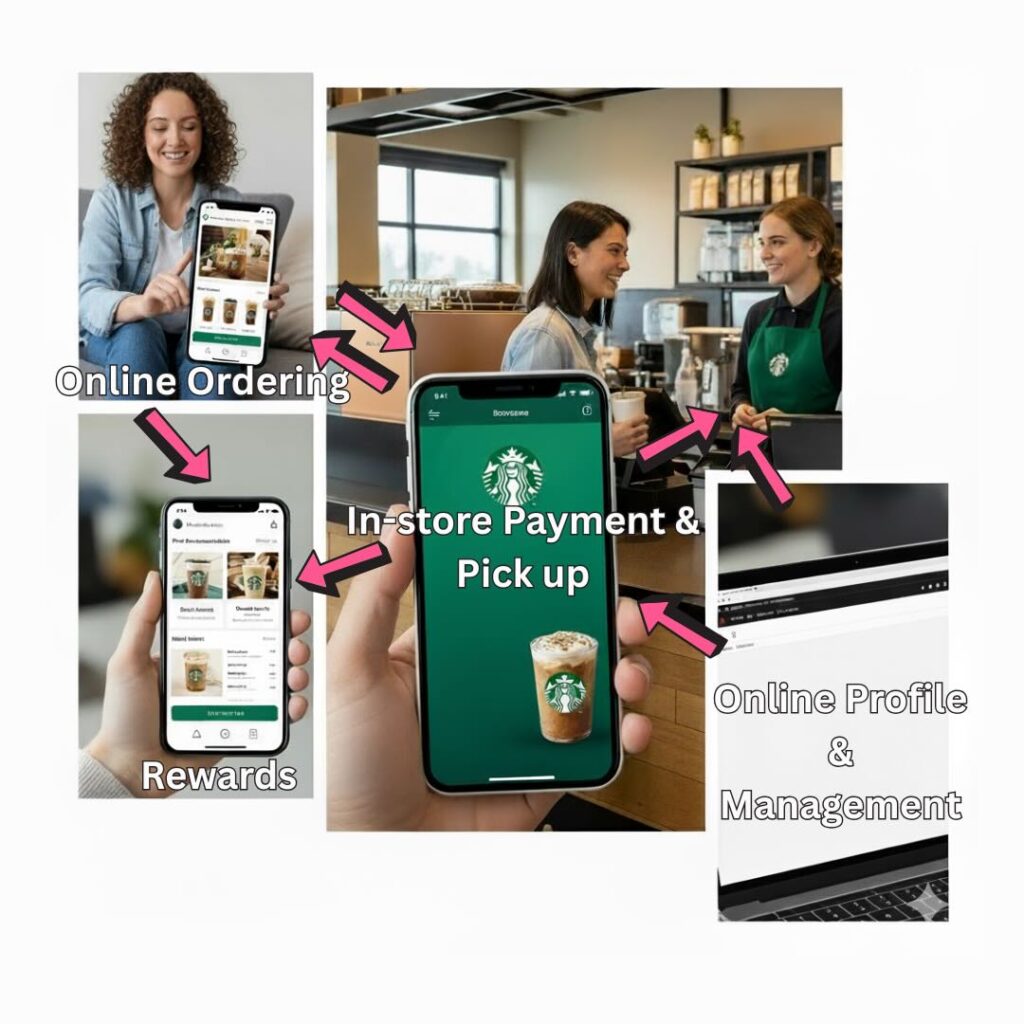
Example: Starbucks Rewards. Order in the app, pick up in-store, and your history stays connected.
- POS & CRM Systems – Cash registers and customer databases talk to each other. Even if you buy as a guest, staff can pull up your history using your email, phone, or card number.
Example: Best Buy. Customer service reps can find your order and continue the conversation seamlessly.
- Cookies & Device IDs – Online activity is saved through cookies, so even if you’re not logged in, your cart or browsing history shows up later.
Example: Amazon. Your recently viewed items appear before you even log back in.
The reality: If a customer never provides any identifier, the connection usually breaks. That’s why businesses encourage small steps like loyalty apps, digital receipts, or online accounts—it helps bridge the gap and create one smooth journey.
Everyday Examples of Omnichannel
Now that we’ve covered how the connections work, let’s look at what omnichannel strategy feels like in action. These real-world examples show how the customer journey flows smoothly across channels:
- Landscaping & Hardscaping: A homeowner browses project photos on Instagram, books a consult on the website, and when the designer arrives, they already know the styles the homeowner liked.
- House Cleaning Services: A new customer books online, gets an automatic SMS reminder, and after the service, receives a thank-you email with a coupon for next time.
- Law Firms: A person downloads a legal guide from the website. When they call in, the receptionist can immediately see what they read and continue the conversation without missing a beat.
- Manufacturers: A buyer downloads a spec sheet, then later speaks with sales. Because the CRM logged their download, the sales rep already knows which product they’re interested in.
In each case, the customer never has to repeat themselves. The business already knows who they are and what they need—so the journey keeps moving forward instead of starting over.
What Is the Best Example of an Omnichannel?
If you want to see omnichannel done right, look at Starbucks.
Here’s why it’s often called the gold standard:
- You order ahead in the mobile app.
- The app shows real-time pickup options at your local store.
- Your rewards points update instantly, no matter how you pay.
- If you reload your balance online, the change shows up on your phone and in-store within seconds.
- The same offers and branding carry through email, app, social, and in-store menus.
- The key is that every channel feels like one experience. Whether you’re ordering in the app, paying in-store, or getting a promo email, it’s all connected.
But omnichannel isn’t just for global giants. Small businesses can do it too.
Take a local cleaning service as an example:
- A customer books online through the website.
- They get an SMS reminder the day before the appointment.
- After the service, the company emails a thank-you note with a coupon for next time.
- If the customer calls in, the receptionist can see their booking history and preferences right away.
It’s the same principle: every interaction—website, text, email, or phone call—feels like part of one smooth journey.
Omnichannel vs. Multichannel: What’s the Difference?
A lot of businesses think they’re doing omnichannel just because they’re on multiple platforms. In reality, that’s only multichannel.
- Multichannel = Presence. You have a website, social media, maybe even a phone line—but they don’t connect. Each channel is its own island.
- Omnichannel = Connection. Those same channels work together so the customer can move between them without starting over.
Example:
- Multichannel: A cleaning service has a website, a Facebook page, and a phone number. Customers can reach them in different ways, but each one is separate.
- Omnichannel: A customer books on the website, receives a text reminder, and when the cleaner shows up, they already know the customer’s preferences. The journey feels seamless.
Why this matters: Multichannel only gives options. Omnichannel gives continuity. The difference is not where you show up, but how those touchpoints work together to guide the customer forward.
Why Omnichannel Marketing Matters
Omnichannel isn’t just a marketing buzzword—it has a real impact on both customers and businesses. The numbers show just how big that impact can be:
- Research shows that companies using strong omnichannel strategies keep close to nine out of ten customers, while businesses with weak strategies hold onto only about one in three. source: https://www.uniformmarket.com/statistics/omnichannel-shopping-statistics
- Shoppers who move between channels—say, website, social, and in-store—end up spending roughly 30% more than customers who only use one channel. source: https://www.mailmodo.com/guides/omnichannel-marketing-statistics
- Marketing efforts spread across three or more channels see purchase rates jump by almost three times compared to campaigns that stick to a single channel. source: https://porchgroupmedia.com/blog/25-amazing-omnichannel-statistics-every-marketer-should-know
- Companies with strong omnichannel engagement report about 9.5% annual revenue growth, while those without see growth closer to 3%. source: https://www.uniformmarket.com/statistics/omnichannel-shopping-statistics
- U.S. sales from “Buy Online, Pick Up In Store” options are projected to reach over $154 billion by 2025, showing how much customers want flexibility between digital and physical shopping. source: https://www.uniformmarket.com/statistics/omnichannel-shopping-statistics
- Studies also show that about four out of five consumers rely on more than one channel to complete a purchase. source: https://www.mailmodo.com/guides/omnichannel-marketing-statistics
- And customers who engage with a brand across multiple channels shop about 1.7 times more frequently than those who stick to just one. source: https://www.amraandelma.com/omni-channel-marketing-statistics
The takeaway is simple: people reward brands that make life easier. Omnichannel creates that seamless experience—turning convenience into trust, and trust into lasting growth. But while the benefits are clear, actually building that kind of connected journey comes with real challenges.
The Challenges of Omnichannel Marketing
Omnichannel marketing is powerful, but building it isn’t as easy as it sounds. Most businesses run into the same obstacles:
- Data silos (systems that don’t talk): Your website collects one set of data, your email tool another, and your sales notes yet another. Without integration, the customer journey feels disconnected. For example, a law firm might capture leads through a guide download but lose that context when the same person calls in.
- Consistency across channels: Offers, prices, and messaging should match everywhere. A cleaning company advertising a discount on Facebook but forgetting to update its website instantly creates confusion and frustration.
- Costs and tools: CRMs and automation platforms can be expensive, especially for small businesses. Choosing the wrong system—or too many systems—can overwhelm teams instead of simplifying processes.
- Team alignment: Employees need training to deliver the same experience online and offline. If a receptionist doesn’t know about the website’s booking system, the omnichannel promise falls apart.
- Privacy and user behavior: Customers don’t always log in, share their email, or join loyalty programs. When no identifier exists, the connection between channels breaks—making the journey incomplete. For example, a shopper might browse online and later visit in-store, but if they never logged in, the sales associate won’t know what they looked at.
How to Overcome These Challenges
The good news? You don’t need a massive overhaul to start closing these gaps. Here are practical solutions:
- Integrate systems step by step: Connect your CRM, website, and POS gradually. Even small integrations—like syncing online bookings with text reminders—improve the journey.
- Keep messaging centralized: Use brand guidelines and shared calendars so promotions and tone stay consistent across every channel.
- Pick tools that fit your size: You don’t need enterprise software to start. Many affordable CRMs and marketing tools work well for small businesses.
- Train your team early: Make sure staff know what systems are in place and how to use them to continue the customer’s journey.
- Offer gentle identifiers: Encourage customers to connect without forcing logins. Options like digital receipts via email, loyalty apps, or even “text me my order status” help bridge the gap while respecting privacy.
Omnichannel doesn’t require perfection from day one. Start by fixing one weak spot—like data silos or consistency—then build from there. Over time, even small changes add up to a customer journey that feels personal, seamless, and trustworthy.
Getting Started with Omnichannel for Small Businesses
The idea of connecting every channel can feel overwhelming—but you don’t need a big budget or a massive tech stack to get started. The key is to begin small, stay consistent, and build step by step.
Here’s a simple roadmap:
- Centralize your customer data. Use one CRM (even a lightweight one) so every interaction—calls, emails, bookings—lives in the same place.
- Connect your booking and communication tools. For example, let online bookings trigger automated SMS reminders or confirmation emails.
- Stay consistent across touchpoints. Keep your branding, tone, and offers aligned—whether it’s on your website, ads, emails, or even printed materials like business cards.
- Automate what you can. Simple automations like thank-you emails, surveys, or loyalty rewards make the customer experience smoother without adding extra work.
- Track performance early. Even basic tracking (like email open rates or booking confirmations) gives you insights to refine the journey over time.
Pro tip: Start by focusing on the channels your customers already use the most. If most of your clients book through your website and communicate by text, connect those first. You don’t need to be everywhere—you just need to make the places you are feel connected.
Even small improvements—like unifying data or sending consistent follow-ups—create the sense of one brand, not a patchwork of disconnected interactions.

Content Marketing and Omnichannel: Not the Same Thing
It’s easy to mix these two up, but content marketing and omnichannel marketing are not the same thing.
- Content marketing is about creating and sharing valuable material—blogs, videos, social posts—to attract and engage your audience.
- Omnichannel marketing is about making sure every channel, and every piece of content, feels connected as part of one journey.
Think of it this way:
- A content strategy might give you a blog post, an Instagram reel, and a YouTube video.
- An omnichannel strategy makes sure those pieces tell the same story and connect smoothly.
In fact, omnichannel can actually make content creation easier. A single customer story, for example, could be:
- Written up as a blog post.
- Turned into short video clips for social media.
- Summarized into an email campaign.
- Recorded as an audio snippet for a podcast.
Instead of extra work, it’s about smarter reuse—one message, tailored for each platform, all working together to reinforce the same brand experience.
Helping Local Businesses with Omnichannel
Running a local business today isn’t easy. Customers have endless choices at their fingertips, and big brands often set the standard for convenience. But here’s the good news: you don’t need a giant budget to compete. With the right omnichannel approach, small businesses can create the same sense of ease and trust that keeps customers coming back.
At DigitalHouze, we’ve seen local businesses thrive when they focus on three things:
- Close the gaps – Look at where customers are slipping away. Maybe online bookings don’t sync with your calendar, or phone inquiries aren’t tracked. Fixing one gap can make a huge difference.
- Choose tools that fit – Forget bloated enterprise systems. Use practical tools that match your size, budget, and goals. A single CRM or booking system can centralize customer info and connect touchpoints.
- Connect the journey – Whether a customer finds you on social, your website, or by walking in, every interaction should feel seamless. Consistency builds trust.
- Strengthen your team – Train staff to deliver the same friendly, reliable experience across channels. Technology matters, but people carry the experience through.
The result? First-time buyers turn into loyal customers. And loyal customers don’t just repeat purchases—they recommend you, leave reviews, and help your business grow in the community.
Why Omnichannel Is the Future of Marketing

The future of marketing isn’t about being everywhere. It’s about making every interaction feel connected—no matter where it happens. Customers expect brands to remember them, anticipate their needs, and remove friction at every step. Omnichannel delivers exactly that.
When channels work together, customers don’t feel like they’re starting over. They trust your brand more, buy more often, and stick around longer. That’s why businesses that embrace omnichannel consistently see higher loyalty, stronger sales, and more efficient marketing.
Picture this: you spot a product in a social ad, check reviews on the website, get a reminder email about a special offer, and then complete the purchase in-store—without missing a beat. That’s not the future, that’s what customers already expect today.
The businesses that master omnichannel won’t just keep up—they’ll stand out. Because in a crowded market, the easiest journey wins.
Omnichannel looks different for every business. Let’s design a version that fits yours. Drop us a message and we’ll share a few ideas tailored to you.